

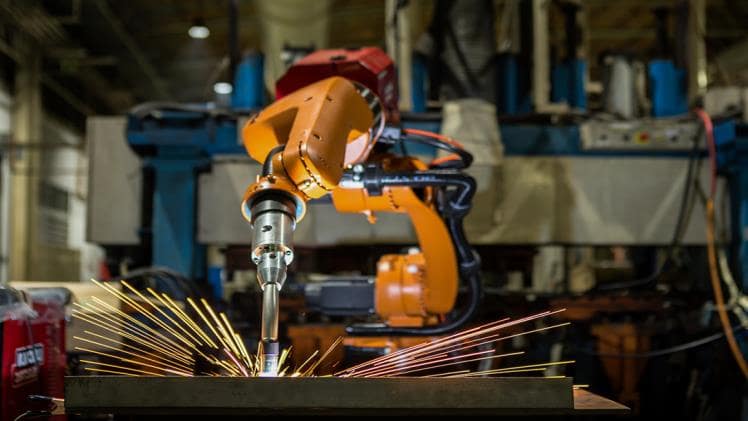
7 Types of Robotic Welding Processes
The following are some of the most common forms of robotic welding:
- Arc welding is a non-contact method of joining materials together. It uses an electric arc between an electrode and a metal base to melt and mix two parts. Arc welding is utilized for tasks that require high precision and consistency.
- Resistance welding is a kind of metal joining in which current is passed between two pieces of metal, creating a pool of heat, and the two pieces are bonded together. Resistance welding is the most cost-effective form of robotic welding, ideal for heat-treating applications.
- Spot welding is a form of resistance welding that joins thin metals that resist electrical currents. It’s typically utilized in the auto sector to join metal frame components together.
- TIG welding is a high-quality process in which an arc is produced between a non-consumable tungsten electrode and the metal component using a consumable tungsten electrode. TIG welding, also known as Gas Tungsten Arc Welding (GTAW), is used when exactitude is required.
- MIG Welding is a high-deposition-rate process in which a wire is fed continuously toward the heated weld tip. It’s also known as Gas Metal Arc Welding (GMAW) and is ideal for applications that demand simple system operation and rapid production.
- Laser welding is a laser machine that uses a fibre optic cable to transmit laser light from the laser generator to a robotic cutting head, which welds pieces together. In high-volume situations where precision is required, such as the automotive sector or in the medical or jewellery industries, remote laser welding for hard-to-reach weld locations is frequently employed
- Plasma welding involves passing ionized gas through a copper nozzle to produce temperatures that are extremely high. Plasma welding is useful for producing flexibility because the speed and heat settings can be readily changed.
If you’d like to find out more about robotic welding, take a look at Cyber-Weld.
